
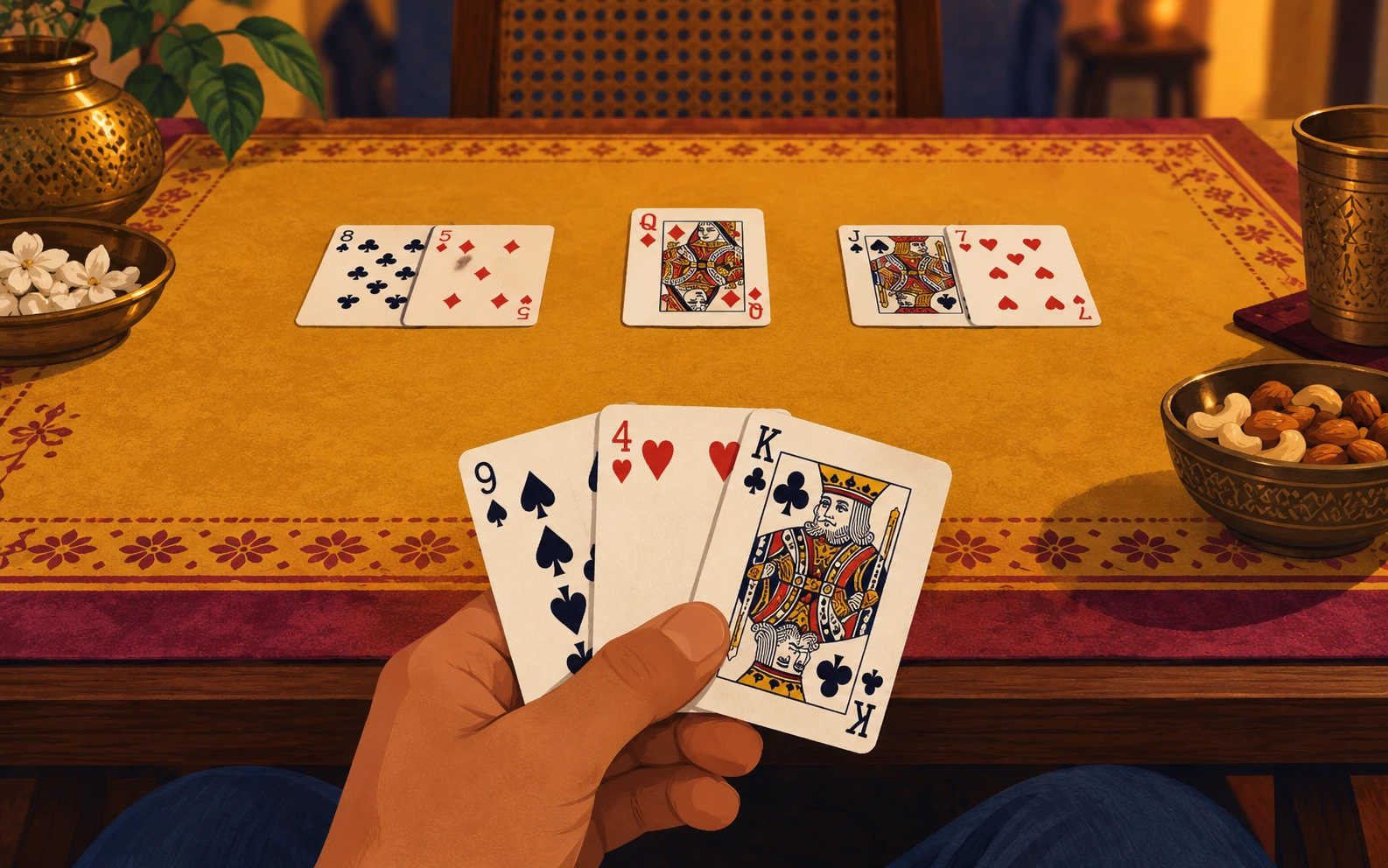
Picture a three-card table with chips already in front of you. You hold a pair of sevens and a stray king. In the Evolution dealer version of Teen Patti, the round starts with an Ante, each player receives three cards, and then chooses to make an equal Play bet or to fold. The dealer must qualify with Queen High or better. Those facts shape the hand: the Play bet costs the same as the Ante, and the dealer threshold is part of the named version's rules. The title and the table rules provide different kinds of information.
Indian card tables ask you to follow different kinds of information. Teen Patti, Andar Bahar and Rummy sit in the same broad family of card play, yet the information each one asks you to track is different. The named Teen Patti dealer version uses a ranked three-card comparison. Another is a matching race between two sides. Rummy is a category that covers several rule sets, so the label alone tells you very little. This piece walks through the questions worth asking at each kind of table, using named external examples and clearly labelled hypothetical hands.

The three-card decision that starts everything
Take the hypothetical hand above and slow it down. In the Evolution dealer version of Teen Patti, the Ante and the Play bet are separate wagers of equal size. The dealer qualifies with Queen High or better. Pair Plus and the 6 Card Bonus are separate wagers with their own outcomes. The provider describes them as optional bets evaluated separately from the main game. Each needs to be read with its own conditions. Before the first card is dealt, the useful questions are simple: what does the dealer need to qualify, what does folding cost me right now, and which of these circles on the table are separate bets?
This is also where the gap between a game name and a game rule shows up. The catalogue lists a three-card table-game title called 100 Teen Patti. That listing tells you a game by that name exists. It does not tell you the dealer qualification rule, the Play-to-Ante ratio or the side-bet structure of that particular version. Two products can share the Teen Patti name and settle differently. Read the table you are actually sitting at.
Follow the match across two sides
Andar Bahar works on a different logic. In the Evolution Super Andar Bahar version, the first card is dealt as a reference card, called the Joker. Cards are then dealt alternately to the Andar and Bahar sides until one side produces a card matching the rank of that Joker. The main prediction is which side matches first. That is a positional race, not a comparison of hand strength.
The side bets shift the question again. In this version, side bets concern how many cards will be dealt before the match appears. That is a count, not a rank. The main result in this named version concerns a matching rank on a side, with a separate card-count question for its side bets. The information you need here is the reference rank, the side currently receiving cards, and the running count if you have taken a side bet on the number of cards.
A hypothetical example makes the difference concrete. Suppose the Joker is a nine of hearts. Cards fall to Andar, then Bahar, then Andar again. You are not building a hand. You are waiting for a card matching that reference rank to land on one of the two sides. If you have backed the count side bet, you are also tracking how many cards have passed. The catalogue also lists a matching-card game called Andar Bahar. Check the rules of that named version rather than assuming it matches the Evolution format described here.
Why a lobby category is not a rule set
A lobby category is a shelf, not a rulebook. When a site groups games under Indian cards, it is telling you where to look. It is not telling you the dealer qualification threshold, the number of decks, the side-bet menu or the settlement order. Those details live in the individual game rules, and they can differ between two titles sitting side by side on the same shelf.
Rummy shows the problem clearly. Desi lists Rummy as a category alongside Teen Patti, Andar Bahar, slots, live dealer and cricket. That is a category claim. It does not name a variant, a deal size, a melding rule or a declaration requirement. A named Rummy version can have its own dealing, grouping and declaration conditions. The category label does not establish those conditions. The correct reading is that Rummy appears as a category, and the rules of whichever named version you open are the ones that govern play.
That distinction is useful even when two tables look similar. A shared card image does not tell you which hand ranking, reference-card rule or optional wager is in use. Read the description attached to the exact title. Then keep the relevant rule beside the feature it explains. A card image introduces the subject; a named rule tells you what the round asks you to follow.
Optional bets and the cost of a busy felt
A crowded betting layout is a design choice, and it changes how much attention a hand demands. In the Evolution Teen Patti version, Pair Plus and the 6 Card Bonus sit alongside the main wager. In the Evolution Super Andar Bahar version, the count side bets sit alongside the main side prediction. In each case, the optional bet has its own stake and its own outcome. Keeping them distinct makes it easier to identify which rule applies to which result.
The practical habit is to count the bets before the first card. If the felt shows four separate wagers, you have four separate decisions. Decide which ones you actually want to place, and leave the rest empty. Additional spaces on the felt mean additional decisions to track. Their presence does not require you to select every one.
Three hands, three different readings
Consider three hypothetical situations and the information each one requires. In the first, you are at the named Evolution Teen Patti dealer table holding a pair of sevens and a king. The dealer has not yet revealed. Your decision turns on the dealer qualification rule, the size of the Play bet relative to the Ante, and whether you have already placed a Pair Plus wager. You are comparing a ranked hand against a threshold.
In the second, you are at the Evolution Super Andar Bahar table. The Joker is a four of clubs. Cards have gone Andar, Bahar, Andar. You are waiting for a four to appear on either side, and if you took the count side bet, you are also tracking the number of cards dealt. No hand ranking is involved. You are following a race and a count.
In the third, you are looking at a Rummy category in a lobby. Before you sit down, you need the rules of the specific named version: how many cards are dealt, how melds are formed, what a valid declaration looks like. The category label gives you none of that. Three tables, three completely different sets of questions. The comparison concerns the information attached to each format, rather than a claim that one choice produces a better result.
What to check before the first card
Start with the named version, not the category. Write down the exact title of the game you are about to open. Then find its rules panel and read the settlement order. For a three-card game, look for dealer qualification and the Play-to-Ante ratio. For a matching game, look for the reference card rule and the side-bet definitions. For Rummy, look for the deal size and the melding rules of that named version.
Then count the wagers on the felt. Separate the main bet from every optional bet, and note which ones you have placed. Finally, check the age and terms position. Desi states 18+ and that terms and conditions apply, and that applies to the welcome offer of up to ₹5,000 plus 25 free spins as advertised. The slogan Khelo smart, jeeto big is a brand line, not a promise of results.
None of this requires memorising every rule set. It requires a short pause at the start of each session. Read the table, count the bets, and confirm which named version you are playing. A clear version name and a readable set of rules give the round its context.
Comparison
| Format | Core decision | What to read first |
|---|---|---|
| Teen Patti (Evolution dealer version) | Ante, then equal Play or Fold; dealer qualifies Queen High or better | Dealer qualification rule and separate Pair Plus and 6 Card Bonus wagers |
| Andar Bahar (Evolution Super Andar Bahar version) | Which side matches the Joker rank first | Reference card rule and side-bet definitions on card count |
| Rummy (Desi category) | Depends on the named variant | The rules of the specific named version; the category label is not a rule set |
Reading checklist
- Identify the exact named version before sitting down
- Read the dealer qualification or reference card rule
- Count every separate wager on the felt
- Check the 18+ and terms position before claiming an offer